Tuesday, June 02, 2009

REAP-Canada Highlighted in two New Articles

Roger Samson and REAP Canada was recently featured in a commentary for The Bioscience Resource Project. The article entitled "The Real Burning Question: Are Liquid Fuels the Best USe of Non-Woody Biomass" discusses the issues surrounding the use of non-woody biomass for liquid biofuels and how liquid biofuels is not be the best use of this type of resource.

Similarly Farmcentre.com published "Renewable Energy and Green Heat" a summary on switchgrass pellets and their use for thermal heating as well as greenhouse gas offsetting benifits.

Friday, May 08, 2009

Biopellet Plant Possibility in Eastern Ontario

An article published in the Cornwall Standard-Freehold highlights work REAP-Canada prepared for Stormont, Dundas and Glengarry Communities Future Development Corporation to assess the possibility of establishing a warm season grass pellet industry in Eastern Ontario.

Canadian Bio Pellet Inc. in Ingleside, the Forman family, James de Pater of Hendrick Seeds and Glen Swerdfiger of DES Environmental are planning to build a mill to turn switchgrass and other organic products into biological pellets fit to be burned for energy production by the fall. The company will be called Switchgreen. The full article is available online here.

Friday, April 17, 2009

Roger Samson: Feature Speaker at Growing Grass for Fuel Pellets Workshop

Roger Samson will be a feature speaker at an upcoming workshop in Nova Scotia on growing energy grasses for fuel pellets. The one day event will outline plans for a strong and healthy grass pellet fuel industry in Nova Scotia, and will offer information on production, and combustion.

Workshop/Registration Details
Growing Grass for Fuel Pellets
Thursday April, 23rd 2009-10am-3pm
Holiday Inn, Prince Street., Truro NS

Registration: (902)-896-0277 or by email r.hutchinson at agrapoint dot ca

Roger Samson: Speaker at International Energy Farming Conference

Roger Samson, Executive Director of REAP-Canada was invited to speak at the International Energy Farming Conference in Papenburg, Germany held on March 10-12, 2009.

This was the third congress and addressed the challenges around the need for action with regard to the implementation of climate protection objectives and concerning increasing demands
on the use of raw materials and energy. One of the objectives of the Energy Farming Congress was to present and discuss possible solutions through sustainably produced biomass and efficient bio-energy technology.

Roger gave a presentation on "Developing energy crops for thermal applications: Optimizing fuel quality, energy security and GHG mitigation". The presentation was based on a recent publication from Springer Science.

***
The full reference for the publication is: Samson R., C. Ho Lem, S. Bailey-Stamler, and J. Dooper. 2008. Chapter 16 “Developing Energy Crops for Thermal Applications: Optimizing Fuel Quality, Energy Security and GHG Mitigation.” 52pp. In D. Pimentel (ed.) Biofuels, Solar and Wind as Renewable Energy Systems: Benefits and Risks. Springer Science, Berlin, Germany.

This book is available from Springer Publishers or online at http://www.amazon.com/Biofuels-Solar-Renewable-Energy-Systems/dp/1402086539

Thursday, April 16, 2009

Farm Co-operative for Switchgrass Growers

A recent article in Small Farm Canada magazine by Steven Biggs describes a pelletizing plant being built in St. Armand by Bio-Combustible International Inc. The article highlights the work done by REAP-Canada and the potential of switchgrass as a feedstock for pellet fuel.

CBC Maritime Noon Interview-They call it "Energy Grass"

REAP Canada was an invited speaker at this years Annual PEI Soil and Crop Improvement Meeting in Charlottetown this past February. Stephanie Bailey Stamler gave a seminar on "Growing Bioenergy Opportunities in Canada" where she discussed growing energy grasses, in particular switchgrass for bioenergy. She was interviewed for CBC radio's Maritime Noon program by Maggie Brown. To listen to the interview click here.

Alternatives Journal Publication-Better Bioenergy


REAP-Canada has a featured article in the latest edition of the Alternative Journal entitled "Better Bioenergy". The article analyzed how effective current bioenergy polices are in Canada and if there is a better way forward. The study found that to be effective, Canada's bioenergy policies need to consider the full lifecycle environmental and economic performance of various technologies. A more effective policy would be for Canada to implemented a policy parity, where different bioenergy options were be subsidized based on their environmental and economic performance. This would move Canada beyond the food-vs-fuel debate, paving the way for the best bioenergy options to emerge.

Stephanie Bailey Stamler, a co-author on the study, was interviewed for the Alternative Journal's monthly Podcast where she discussed the findings of the article. To hear the podcast click here.

For further information on the article click here.

Monday, January 19, 2009

Great Lakes Grass Energy Symposium Final Program

January 22nd, 2009 1:00pm-5:00pm UC103 at the Guelph Organic Conference:

The speakers for our upcoming symposium have been finalized. There is still time to register for this exciting educational exchange on the grass energy industry. The symposium will begin with presentations from grass energy specialists covering grass production, harvest, densification and combustion. The day will end with updates from energy grass growers and a wonderful opportunity for question and answers.

Featured Speakers:
1:05-1:35 Dr. Paul Salon- Plant Materials Center USDA NRCS, Big Flats NY
1:35-2:05 Mr. Roger Samson-Executive Director, REAP-Canada, Montreal QC
2:05-2:35 Dr. Martin Roberge- Project Engineer, Case New Holland, Saskatoon SK
2:35-3:05 Dr. Fernando Preto- CanmetENERGY, NRCAN, Ottawa ON
3:05-3:20 Coffee Break
3:20-3:45 Mr. Rick Minke-Ekofuel Technologies, Walkerton, ON


Grower Experience Exchange Panel
3:45-4:00 Calvin Ernst- Founder, Ernst Conservation Seeds, Meadville PA
4:00-4:15 Don Nott- Nott Farms, Clinton ON
4:15-4:30 Ingrid Marini- Rural Association for Clean Energy, St. Armand QC
4:30-5:00 Question Period


Registration is online or at the door (www.guelphorganicconf.ca/thursday09.html).

REAP-Canada's Annual General Meeting

January 22nd, 2009 9:15am-12:15pm at the Guelph Organic Conference
University of Guelph (Rm UC103)

Come meet the staff behind REAP-Canada and learn about the exciting projects we have been working on over the last year.

In conjunction with the AGM we are please to host a roundtable discussion on growing energy grasses for the bioheat Industry. Participants will include speakers from our afternoon "Great Lakes Energy Grass Symposium", REAP Board Members and Staff.

This event is open to all REAP members. Non-members may purchase a REAP-Canada annual individual or organizational membership for $25 or $100 respectively either online or at the event (http://www.reap-canada.com/store.htm).

We look forward to seeing you this week!

Monday, December 08, 2008

REAP-Canada Presents: The Great Lakes Grass Energy Symposium

Thursday January 22nd, 2009, 1:00pm – 5:00pm at the Guelph Organic Conference

Getting Back to the Basics

This symposium will feature leading technical specialists and farmers from the Great Lakes region who are developing warm season grasses for energy. Specific topics to be covered by leading invited experts from New York, Ontario Pennsylvania, and Quebec who will discuss:

  • Best management practices for establishing native grasses
  • Available native grass cultivars and potential to improve yield through
    breeding
  • Recent technology developments for improving mowing and baling of energy
    grasses
  • Creating biomass quality in grasses to ensure high quality combustion
  • Experiences with low cost briquetting of switchgrass and burning warm season grasses in commercial boilers.

Guest speaker panel:
*Daniel Arnett- Biomass Coordinator, Ernst Conservation Seeds, Meadville PA
*Dr. Fernando Preto & Irene Coyle-
CANMET Energy Technology Centre, NRCAN, Ottawa ON
*Dr. Martin Roberge-
Project Engineer, Case New Holland, Saskatoon SK
*Dr. Paul Salon-
Plant Materials Center USDA NRCS, Big Flats NY
*Roger Samson-
Executive Director, REAP-Canada, Montreal QC

Farmer Experience Exchange:
A grower panel will report on their personal experiences, challenges and opportunities in growing energy grasses. This will be a unique opportunity to learn the current status of the emerging Great Lakes grass energy industry in a focused symposium.

Growers Panel:
*Calvin Ernst- Founder, Ernst Conservation Seeds, Meadville PA
*Ingrid Marini- Rural Association for Clean Energy, St. Armand QC
*Don Nott- Nott Farms, Clinton ON

Don’t miss this exciting opportunity to stay up to date on energy grass technological advances and to network with farmers, bioenergy project developers, industry and government.

For more information and to register, click here: http://www.guelphorganicconf.ca/thursday09.html

Roger Samson: Keynote Speaker at the Energy Grass Symposium-Building a Viable Grass Energy Economy

Roger Samson recently attended the Energy Grass Symposium in Vermont on November 12th, 2008. He gave the keynote address entitled: Building a Viable Grass Energy Economy.

To view Roger Samson’s presentation, click here: http://www.vsjf.org/biofuels/documents/SampsonGrassEnergyPresentation111208.pdf

To read about the symposium, click here: http://www.vsjf.org/biofuels/Grass_Pellets.shtml

Thursday, October 02, 2008

New Canadian biofuel technology 570% more efficient than corn ethanol in reducing greenhouse gases

For Immediate Release

(Montreal, QC) -A study by Canadian and Dutch scientists just released in a book by Springer Publishers found that commercial second-generation solid biofuel technology has set a new Canadian benchmark in greenhouse gas (GHG) displacement. The solid biofuel technology using biomass from energy crops for heat energy developed by REAP-Canada reduces GHG’s by 7,600-13,100 kg CO2e /ha. By comparison soybean biodiesel and corn ethanol were found to reduce GHG’s by 900 and 1,500 kg CO2e/ha respectively.

“Solid biofuels produced from 2nd generation energy crops, such as switchgrass, effectively blow away liquid biofuels like corn ethanol as a serious greenhouse gas mitigation option” explained Roger Samson, Executive Director of REAP-Canada and lead author of the study.

REAP-Canada is calling on the federal and provincial governments to work jointly to implement a national solid biofuels GHG mitigation strategy. “Solid biofuels are 570% more efficient than liquid fuels in using farmland to mitigate GHG’s yet there are no subsidies in Canada for such technologies. In the race to reduce GHG’s, solid biofuels are the winning horse while liquid biofuels are a donkey” stated Samson.

The study also offers several recommendations on how energy from solid biofuels can be developed efficiently and equitably across Canada.

***
The full reference for the article is: Samson R., C. Ho Lem, S. Bailey-Stamler, and J. Dooper. 2008. Chapter 16 “Developing Energy Crops for Thermal Applications: Optimizing Fuel Quality, Energy Security and GHG Mitigation.” 52pp. In D. Pimentel (ed.) Biofuels, Solar and Wind as Renewable Energy Systems: Benefits and Risks. Springer Science, Berlin, Germany.

This book is available from Springer Publishers or online at http://www.amazon.com/Biofuels-Solar-Renewable-Energy-Systems/dp/1402086539

For more information:
Roger Samson (
rsamson(at)reap-canada.com)
REAP-Canada
Box 125, Centennial Centre CCB13,
Ste Anne de Bellevue, Quebec, H9X 3V9
Tel. (514) 398-7743; www.reap-canada.com


Resource Efficient Agricultural Production (REAP)-Canada is a not-for-profit organization that focuses on sustainable biofuel systems development. A world leader in developing bioenergy for greenhouse gas mitigation and rural development, REAP-Canada provides services in bioenergy research, policy and market development. The agency has 17 years of experience in energy crop development, biomass resource assessments and bioenergy conversion technologies in industrialized and developing nations.

Thursday, June 12, 2008

Biofuels should run on solar energy not on taxpayers dollars

Published: Wednesday, June 11,2008 Montreal Gazette
Roger Samson, Freelance

The ability of plants to capture and store solar energy through photosynthesis holds great promise as a renewable energy solution for mankind.

However, agriculture must maintain its primary energy production role: creating nutritious food for the human body. Can we develop sustainable biofuels and ensure a continuous supply of fairly priced food for the people of the world?

Traditionally, agriculture has had a surplus production capacity. In fact, low farm commodity prices in the last several decades have even forced governments to set land aside. Now, however, the surplus production capacity of the agricultural sector is increasingly modest. This is especially true of cereal crops such as corn and wheat, which are staple foods for the majority of people around the world.

The UN Food and Agriculture Organization reported that last year there was a 4.6 per cent increase in cereal grain production. But because of higher demand for these cereals year-end global grain stocks decreased by 5 per cent.

At the same time a record 100 million tonnes of cereals were used last year as biofuels. If these grains hadn't been used to produce fuel, there would have been an increase in grain stocks of approximately 12 per cent.

So, why are cereals being so widely used for biofuel production? After all, it is well known that corn-based ethanol is not an efficient way to convert solar energy into fuel. Indeed, the energy balance of corn ethanol is barely positive, meaning that it takes almost as much energy to produce the fuel as is eventually created by it.

The truth is that ethanol runs on corporate lobbyists convincing governments to subsidize it with tax revenues. Meanwhile, other more sustainable biofuel options get no subsidies despite the fact they produce 700 per cent more net energy gain and carbon dioxide offsets than corn ethanol from each acre of farmland.

So, just how big are the corn ethanol subsidies? In Ontario (a net importer of U.S. corn), the combined provincial and federal subsidies last year were about 16.7 cents per litre of ethanol produced. This whopping incentive effectively creates a $64 per tonne subsidy for corporations to import U.S. corn to make ethanol in Ontario. And voila! Another driver of inflation on world cereal prices. Ontario taxpayers have deeper pockets than the poorest nations in the world and they are able to reach deeper into the world food basket to produce biofuels if they so desire.
This year, an additional 25 million tonnes of cereals will be taken out of the global food basket as taxpayer subsidies enable high-priced corn to be made into ethanol. Speculators are in their glory as they realize the U.S. will not have enough corn to meet the projected demand for ethanol, feed and traditional export markets. There is nothing they love more than a commodity shortage to drive up prices and so cereal grain prices have risen across the board.


Food inflation in the last year has subsequently increased by 4.5 per cent in the U.S., 6.9 per cent in Europe, 23 per cent in China, and 35 per cent in Sri Lanka. Not surprisingly, food crops for fuel are being vilified as a crime against humanity.


The first thing that can be done to make biofuels more sustainable is to use crops that more efficiently capture solar energy than cereal grains and oilseeds. The best options are energy crops that can do this on marginal farmlands. This would minimize conflict with the global food supply. Resource-efficient native perennial grasses like switchgrass are adapted to these lands and can produce 40 per cent more net energy gain per acre than corn.

We must also efficiently convert the biomass (captured solar energy) into a useful energy form. Scientists now understand that liquid fuels are the losers in the energy conversion game. It's much more energy efficient to produce biogas and fuel pellets from biomass to replace fossil fuels. In a race to create energy security and greenhouse gas abatement, whole plant biomass crops converted into pellets or biogas beat turning seed crops into liquid biofuels hands down.

So how can we create a policy framework to support sustainable biofuels? Well, it will only happen when the federal government gets out of the business of picking technology winners with taxpayer money and instead creates greater parity in the use of incentives to reward genuine climate-friendly technologies.


Adopting the proposed 1-2-3-4-5 renewable energy program would be a step forward. It stands for one national renewable energy-climate change program, $2 per gigajoule (a gigajoule (GJ) is a measure of energy) for green heat, $3 per GJ for biogas, $4 per GJ for green power and liquid biofuels, and the 5 stands for a required 50 per cent reduction in green house gases before the technology is eligible for the incentive.

The food vs. fuel crisis is not going to go away until countries like Canada reform our subsidies. These must support biofuel technologies that efficiently run on solar energy and use marginal farmland.

Roger Samson is executive director of Resource Efficient Agricultural Production-Canada.

Monday, March 17, 2008

REAP-Canada addresses Biofuels and Bill C-33

On February 26, 2008, REAP-Canada addressed the House of Commons Standing Committee on Agriculture on Biofuels and Bill C-33.

To view the brief presented entitled: Analyzing BioFuel Options: Greenhouse Gas Mitigation Efficiency and Costs
click here
http://www.reap-canada.com/library/Bioenergy/AAFC_Standing_Committee_Briefing.pdf

To view minutes of the standing committee meeting, click here: http://cmte.parl.gc.ca/Content/HOC/committee/392/agri/evidence/ev3299494/agriev17-e.htm#T0935

Wednesday, February 06, 2008

CFBMC Agriwebinar Presentation by Roger Samson: Switchgrass for BioHeat in Canada

Roger Samson recently did a live online presentation (agriwebinar) in cooperation with the Canadian Farm Business Management Council (CFBMC) entitled: Switchgrass for BioHeat in Canada

To view this presentation on-line, please follow these steps:
1. Visit www.agriwebinar.com and click on “past agriwebinars”
2. Enter your email address to login
3. Click on “VIDEO” for Roger Samson broadcast February 4, 2008

Thanks for watching!

Monday, January 28, 2008

Solid Biofuels Least Expensive Way to Cut GHGs: BIOCAP

For Immediate Release January 23, 2008

(Kingston, ON) — The BIOCAP Canada Foundation released today a report “Analysing Ontario Biofuel Options” prepared by REAP-Canada showing that biomass pellets offer a more cost-effective way for government incentives to reduce greenhouse gas emissions in Ontario when compared to other renewable energy incentives in the province. The proposed solid biofuels incentive would outperform not only existing incentives for other types of bioenergy, but also those for wind and solar power.

David Layzell, President and CEO of BIOCAP, called the report’s findings striking. “This study demonstrates how an incentive program for the large-scale production and use of solid biofuels for commercial and industrial applications could be an effective and sustainable way to grow our economy. The use of biomass pellets – which can be produced from wood, switchgrass or straw – would not only create new market opportunities for the forest and agricultural industries, it would reduce dependence on coal as well as the greenhouse gas (GHG) emissions associated with coal use in Ontario.”

The study, authored by REAP-Canada with a contract and detailed input from BIOCAP, compared the cost of incentives for alternative energies such as wind, solar, biodiesel, corn ethanol and biomass pellets in contributing to energy needs of society ($ per gigajoule thermal or electrical energy) and in reducing GHG emissions ($ per tonne CO2 equivalent avoided).

The results showed that even a relatively small incentive for solid biofuel feedstocks of $4 per gigajoule of energy would offset greenhouse gas emissions at a cost of less than $50 per tonne CO2 – half the price of an offset from biodiesel, and 1/8th the price of an offset from corn ethanol. The $50 price tag also comes in slightly below that for wind power, which currently has the most cost-effective green energy incentive already available in the province of Ontario.

“This report debunks the myth that Ontario is unable to mitigate greenhouse gases affordably, clearly there are low cost solutions like biomass pellets, the urgent need is for policies to be strengthened to allow efficient technologies to emerge ” explained Roger Samson, the lead author on the report and Executive Director of REAP-Canada.

The study also offers several recommendations on how energy from solid biofuels can be developed efficiently and equitably.

The full report is available at http://www.biocap.ca/ and http://www.reap-canada.com/ (http://www.reap-canada.com/library.htm)

BIOCAP Canada is a national not-for-profit foundation that has spent the last ten years bringing together researchers, industry, government and NGOs to provide the insights and technologies necessary to develop a sustainable bioeconomy.

Resource Efficient Agricultural Production (REAP)-Canada is a not-for-profit organization that focuses on sustainable biofuel systems development. A world leader in developing bioenergy for greenhouse gas mitigation and rural development, REAP-Canada provides services in bioenergy research, policy and market development. The agency has 17 years of experience in energy crop development, biomass resource assessments and bioenergy conversion technologies in industrialized and developing nations.

Wednesday, January 16, 2008

REAP-Canada Seminar "BioEnergy Options for Ontario Farmers"


REAP-Canada presents


BioEnergy Options for Ontario Farmers


Friday January 25th, 2008, 9:00am - Noon
2008 Guelph Organic Conference Workshop
Guelph University Centre, Guelph Ontario $45 at the door

This workshop offers discussions on the following topics:
Assessment of biofuel options for producing energy and mitigating GHG’s from Ontario farmland
A review of the emerging opportunities in producing bio-energy in Canada for farmers, focusing on the four primary options available: biodiesel, biogas, bioheat and ethanol. Each fuel will be evaluated for the following: bio-energy feedstock options and the latest production technologies; relative efficiency of conversion technologies; effectiveness of biofuel in mitigating GHG’s; and costs of biofuel incentive programs in Ontario (on a per GJ basis)

REAP-Canada speaker panel:
*Roger Samson, Claudia Ho Lem & Stephanie Bailey Stamler

Strategic opportunities for developing climate-friendly fuels from agriculture
Policy strategies need to be developed to more effectively apply incentives to encourage GHG abatement through creating a competitive bio-energy marketplace and focusing efforts on the CO2 abatement potential of each fuel.

Guest speaker panel:
* Keith Stuart – World Wildlife Fund
* Shannon Watt – Canadian Federation of Agriculture
* Jose Etcheverry – York University / David Suzuki Foundation
* Ingrid Marini – Rural Association for Clean Energy/Association rurale pour une énergie propre (RACE/AREP) * Mahendra Thimmanagari - Ontario Ministry of Agriculture, Food and Rural Affairs (OMAFRA) - Moderator

Register online at http://www.guelphorganicconf.ca/
For further details contact: (514) 398-7743

Introducing the new REAP-Canada BioHeat DVD Seminar Series!


For $30 (plus shipping) you will receive 2DVD’s + bonus powerpoint CD


These DVD’s record the proceedings of the BioHeat: A GROWING AGRI-ENERGY OPPORTUNITY seminar held Thursday Jan 25th, 2007 in conjunction with the Guelph Organic Conference.

It is an excellent introduction for farmers, energy consumers, researchers and bio-energy project developers on the emerging “BioHeat” Industry

DVD1: Biomass Resource Options & Environmental Issues
•Roger Samson of REAP-Canada - “BioHeat 101”: Optimizing warm-season grass production for BioHeat
•Claudia Ho Lem and Stephanie Bailey of REAP-Canada – Biodiversity and water quality benefits of perennial grasses and BioHeat potential to mitigate GHG emissions”

DVD2: Economics, Combustion & Densification
•Tom Adams of Energy Probe - “Can Renewables Score Goals with Energy Consumers? The economics’ of switching from conventional heating and BioHeat vs. fossil fuels in the Canadian economy”
•Fernando Preto of NRCAN – Combustion technologies for residential and commercial heating and densification processes, pellet processing costs and processing of agri-fibre fuels”
•Don Nott of Nott Farms and the Greenhouse Panel including Jack Greydanus and Ken Tigchelaar - Farmers experience with the emerging BioHeat industry”

DVD’s are now available for sale at www.reap-canada.com/store.htm

Labels: , ,

REAP-Canada Seminar List for Winter 2008

January 24, 2008 - Toronto, Ontario (4-6pm)
Roger Samson: Creating Parity in Renewable Energy Policies in Ontario
University of Toronto Bioenergy Policy Speaker Presentation- Department of Political Science,
Contact Mark Purdon for more information (647) 300-3990, mark_purdon(at)fastmail.fm

February 4, 2008 - Online Agriwebinar (12-1 pm)
Roger Samson: Switch grass for bio heat in Canada – Is it time to plant?
Agriwebinar Presentation,
Canadian Farm Business Management Council (CFBMC) www.agriwebinar.com

February 7, 2008 - Toronto, Ontario
Stephanie Bailey Stamler: Growing Switchgrass in Ontario and its’ Potential as a Commercial Pellet Fuel
Agro-Biomass Workshops: Money from agricultural waste and energy crops and Fuelling and powering your farm with biomass,
CANBIO and the Ontario Federation of Agriculture at the Canadian International Farm Equipment Show www.canbio.ca

April 2-5, 2008 - London, Ontario
Stephanie Bailey Stamler: Switchgrass as a Potential Commercial Pellet Fuel in Ontario - Delayed Harvest Study Results
Roger Samson: Assessment of Biofuel Options for Producing Energy from Ontario Farmland
OMAFRA Growing the Margins Conference: Energy, Bioproducts and Byproducts for Farm and Food Sectors Conference,
Ontario Ministry of Agriculture, Food and Rural Affairs (OMAFRA) www.gtmconf.ca

REAP-Canada 2008 Annual General Meeting (AGM)

Please come to our 2008 AGM!

Saturday January 26, 2008 - Guelph, Ontario
12:00-1:30pm Room UC335
3rd Floor, University Centre, University of Guelph
Contact (514) 398-7743 for more information

Thursday, October 04, 2007

REAP-Canada at the Civil Society meeting on the special theme of the 2007 Commonwealth Finance Ministers Meeting: Climate Change and Poverty Reduction


REAP-Canada Climate Change Project Manager Stephanie Bailey Stamler was nominated by the Canadian Environmental Network to act as a delegate for the Civil Society meeting on the special theme of the 2007 Commonwealth Finance Ministers Meeting: Climate Change and Poverty Reduction in Georgetown, Guyana in July 2007. The three day discussion identified consensual commonwealth civil society priorities, issues and recommendations on developing an agenda for growth and livelihoods and a statement was developed for presentation to the Commonwealth Finance Ministers Meeting in September 2007. To see the statement developed from the consultation, click here.

Wednesday, August 22, 2007

“The Gambian Experience”- A Short film about Life in the Gambia by Carla Carpio


Carla Carpio, 2003-2004 REAP-Canada International Intern has just completed a short film based on her experiences in the Gambia. Set to music byMass Lowe, The Gambian Experience vividly details the Gambian way of life including farming, religion, culture and people in the country.

To view The Gambian Experience, produced and directed by Carla Carpio, please click on the link below:
http://video.google.ca/videoplay?docid=5357060501446442053

Tuesday, July 31, 2007

Gaining Ground in Gambia - Fri Aug 10th!


The Gambia, located on the west coast of Africa, is a country in need of help; the expansion of the Sahara Desert is leading to decreased soil fertility and dangerous droughts. On August 10, 2007, REAP-Canada will host a fundraising musical event to continue support of agricultural devlopment and soil conservation projects in the country. All proceeds from the evening will go directly to the Gambian communities to assist them in developing sustainable farming practices. The fundraising target of $5000 from the event will go towards introducing Bokashi organic fertilizer production to 13 villages, income generation for the farmers, ecological farming and soil conservation trainings in each of the villages and the introduction of improved cooking appliances such as the Mayon Turbo Stove to reduce wood used for cooking. For more information on these and other efforts by REAP-Canada to make farming more sustainable, please visit www.reap-canada.com.

Join REAP-Canada at the Union Church in Ste Anne de Bellevue, 24 Maple Ave, 7:30 p.m. August 10th 2007. Admission is $10. For further information call 514-398-7743 or email info@reap-canada.com. Click here for directions. If you're unable to make it, please consider making a donation to Gaining Ground in Gambia (GGIG).

To get your tickets on-line or make a donation, just go to our website www.reap-canada.com and click on the Canada Helps icon. Enter GGIG in the message line and be sure to include your name and contact information. Thanks for your support and see you there!!!

Labels:

Thursday, June 21, 2007

Meet REAP-Canada’s 2007 New Summer Team!

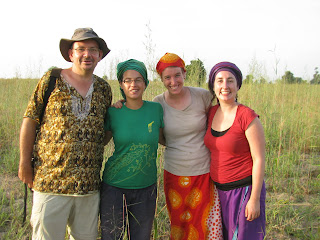
(From L - Right are): Andrea Hart, Jeroen Dooper, Sjoerd Mulder, Tori Ingram and Karen Clark

Tori Ingram and Karen Clark are REAP’s newest CIDA international interns, heading to Gambia at the end of the summer. Tori is currently completing her M.A. in Political Science from York University, specializing in global political economy and international development and also has a B.A.H. in Biology and International Development from Queen's University. Her previous development experience includes an internship with Global Service Corps as a bio-intensive agriculture (BIA) facilitator in Tanzania and four years working with QPID on sustainable development projects in Guyana, Bolivia, Nicaragua, Nunavut and West Africa. Karen is currently completing her M.Sc. in Soil and the Environment from Laval University and has a B.Sc. in Environmental Science from the University of Guelph. Her previous experience includes working as a research assistant for Agriculture and Agri-Food Canada and for the Animal Production and Manure Management Network at the University of Guelph.

Jeroen Dooper and Sjoerd Mulder are REAP’s International Research Associates from the Netherlands. Jeroen is currently pursuing an M.Sc degree in Sustainable Development, energy and resources at the Utrecht University and he has previous work experience at Econsultancy environmental consulting and the Avans University of Professional Education. Sjoerd is currently enrolled in the Agri-Systems Management course at Larenstein University of Professional Education, specializing in Rural Development and Innovation. He has had previous work experience in Greece, China and Canada working in agricultural, horticultural, herb and flower production.

Andrea Hart, REAP’s new Communications Officer holds a Bachelor of Arts with a major in English and minor in Communication from the University of Ottawa. She has previous experience working in the marketing department of a small business while independently investigating various aspects of the media.

Labels: , , , ,

Wednesday, June 20, 2007

Farm Show Magazine - Overwintered Switchgrass Makes Superior Pellet Fuel

Volume 31 No. 3 Published May-June 2007 (page 25)

Labels: , , ,

Wednesday, April 04, 2007

REAP-Canada 2007-2008 International Internships now available!


2007-2008 Ecological Farming Systems Development Intern – The Gambia


Two international internship positions are now available, applications will be accepted until April 30th, 2007.

Each year, REAP-Canada offers young Canadians an opportunity to gain exposure in the fields of sustainable agriculture, renewable energy and international development through the CIDA International Youth Internship Program. The internship includes a 9 week term with REAP-Canada based in Ste. Anne be Bellevue Quebec followed by a 6-month placement in the Gambia the local southern partner the Njawara Agricultural Training Centre (NATC).

To learn more about these youth internship positions, please visit our website www.reap-canada.com.

Friday, February 02, 2007

Better Farming Magazine: BIOENERGY - The Crop That Could Save the Ontario Farm

Don Nott and Roger Samson Published in the "Beyond Ethanol" December 2006 Edition of Better Farming Magazine
Article by Don Stoneman, Coverstory/page 14-21

"In 30 years, says one expert, half of Ontario's farmland will be growing energy crops. And one big-time former cash cropper in Huron County is transforming his operation accordingly in the belief that this prediction is on the mark."


Labels: , , , ,

Wednesday, January 31, 2007

Bioheat use heating up, conference hears


GUELPH (Jan 26, 2007) -- With oil prices hitting the roof, David Steele is searching for ways of saving energy. Steele was among 100 farmers and agricultural researchers who listened intently to a presentation about the emerging bioheat industry, which is reaching new ...

See the Gueph Mercury for the full text of the article (subscribers only)


Friday, January 12, 2007

REAP-Canada Seminar List for Fall/Winter 2007

April 11th – 13th, 2007 – London, ON
Stephanie Bailey: Biomass Resource Options: Creating a Bioheat supply for the Canadian Greenhouse Industry
Roger Samson: The Potential of Switchgrass for Commercial Fuel Pellet Production in Ontario OMAFRA Growing the Margins: Energy Conservation and Generation for Farms and Food Processors, Ontario Ministry of Agriculture, Food and Rural Affairs (OMAFRA) www.gtmconf.ca

March 20-23rd, 200 – Bangalore, India
Roger Samson: Opportunities and Barriers for Household Cookstoves in the CDM and Voluntary Markets 3rd Biennial Partnership for Clean Indoor Air Forum, Partnership for Clean Indoor Air (PCIA) www.PCIAonline.org

March 13-15 th, 2007 – Papenburg, Germany
Roger Samson: Grasses for Heat Related Energy Second International Energy Farming Congress, 3N – Centre of Excellence Renewable Resources www.3-n.info

February 24th, 2007 - Cornwall, ON
Roger Samson: Growing BIOHEAT Opportunities for Switchgrass and other Biofuel options Eco Farm Day 2006 - “Agriculture for Health and Nutrition”, Annual conference organized by Canadian Organic Growers (COG-Ottawa) www.cog.ca/ottawa/EFD_2007_main.htm

February 16 th, 2007 - Ottawa, ON
Roger Samson: Switchgrass Bioenergy: a Growing Opportunity for the Agricultural Sector Policy Presentation at Agriculture Canada Contact: Pierre-Yves Gasser GasserPY@AGR.GC.CA

February 6th, 2007 - Chesterville, ON
Roger Samson: Switchgrass as an Energy Crop in Eastern Ontario Hendrick Seeds Grower Meeting Contact: Michael Staebler MichaelS@HendrickSeeds.com

January 25th, 2007 - Guelph, ON
Roger Samson: BIOHEAT: 'A Growing Agri-Energy Opportunity'
This 1/2 day BioHeat seminar is an introduction to the emerging "BioHeat Industry" for farmers, energy consumers and bio-energy project developers, Guelph 2006 Organic Conference - "Next Generation Organics" www.guelphorganicconf.ca


January 24th, 2007 – Edmonton, AB
Roger Samson: Bioenergy: a Growing Opportunity for the Agricultural Sector
FarmTech 2007 Conference: Global Perspectives … Local Knowledge www.farmtechconference.com

January 18th, 2007 - Fergus, ON
Stephanie Bailey: Growing BioEnergy Opportunities in Canada Wellington-Dufferin Soil and Crop Meeting www.ontariosoilcrop.org

November 18th, 2006 – Ste. Anne de Bellevue,QC
Claudia Ho Lem: Growing BioEnergy Opportunities in Canada 6th Annual Rendez-vous bio, McGill MacDonald Agro-Ecology Group (MAEG) agroecology.macdonald@mcgill.ca

November 14th, 2006 – Regina, SK
Roger Samson: Biomass Energy Alternatives from Energy Crop Farming in Canada Frontier Centre Policy Workshop, Frontier Centre for Public Policy (FCPP)
http://www.fcpp.org/main/events_detail.php?EventID=142
http://www.fcpp.org/main/media_file_detail.php?StreamID=502
http://www.fcpp.org/pdf/SamsonenergyalternativesIINov06.pdf


November 12th – 13th, 2006 – Saskatoon, SK
Roger Samson: Opportunities for Developing Bioheat on the Prairies Organic Connections Conference – 2006, Organic Connections http://www.organicconnections.ca/content/program.html

October 31st - November 1st, 2006 - Ottawa, ON
Roger Samson: The Current Scope of Biomass Opportunities
Towards a Sustainable Bioeconomy: Biosphere solutions for energy and the environment (2006 National BIOCAP Canada Conference) BIOCAP Canada http://www.biocap.ca/index.cfm?meds=section§ion=67&category=24

October 19th, 2006 - Québec, QC
Roger Samson: La bioénergie: opportunités croissantes pour le secteur agricole CRAAQ l’assemblée générale annuelle, Centre de référence en agriculture et agroalimentaire du Québec (CRAAQ) http://antenne.craaq.qc.ca/vol11/ComitesCommissions.aspx

October 10th – 13th, 2006 - Harrisburg, Pennsylvania
Roger Samson: Developing Warm-Season Grasses as a Densified Heating Fuel
5th Eastern Native Grass Symposium, United States Department of Agriculture – Natural Resources Conservation Service (NRCS) http://www.pa.nrcs.usda.gov/engs.html

September 26th, 2006 – Montreal, QC
Claudia Ho Lem: Growing BioEnergy Opportunities in Canada McGill School of Environment ENVR401: Environmental Research

September 15th – 17th, 2006 -Peterborough, ON
Roger Samson: Native warm season grasses: Potential energy crops for biogas production in Ontario Farming for the Future Conference: Biogas Technology, Agricultural Resources, Renewable Energy, Farm Income, Rural Development, and Sustainable Communities, Trent University Food and Agriculture Group & The Canadian Biogas Association www.biogas.ca

For a review of last winters speaking tour, please visit the Frontier Centre website

http://www.fcpp.org/main/events_detail.php?EventID=120

Thursday, December 14, 2006

Crop pellets prove to be hot idea - Farmer sees a profitable future in turning crops like oats and switchgrass into biofuel

By Frances Anderson, April 4th, 2006
Last fall cash cropper Don Nott got a phone call that has changed his life. The caller wanted to know whether Nott thought the oat pellets he markets would burn. Nott has been pelletizing the hulls and other by-products of his oat milling business for nearly a decade, but he'd not considered them for fuel until the day that Roger Samson called.

Six months later, the pellets have proven they burn hot and clean and cheap enough in boilers that greenhouse operators are impressed, and Nott is a man converted, preparing for the end of the age of oil, and a future for farmers in growing fuel - oats in the short term, and switch grass down the road.

"Agriculture has a bright future for some pretty dark reasons," quips Samson, who declares "the grass farmers of North America will outproduce the tar sands one day." …

For the text of the full article, please see the Organic Agriculture Center of Canada website
http://www.organicagcentre.ca/NewspaperArticles/ontfarmer_pellets_biofuel.asp

Ontario Farmer © Copyright 2006, Sun Media Corporation